Taiwan's 5% GDP Defense Budget Still Not Enough: How Big is America's Bill
The Storm Media Opinion, September 11, 2026
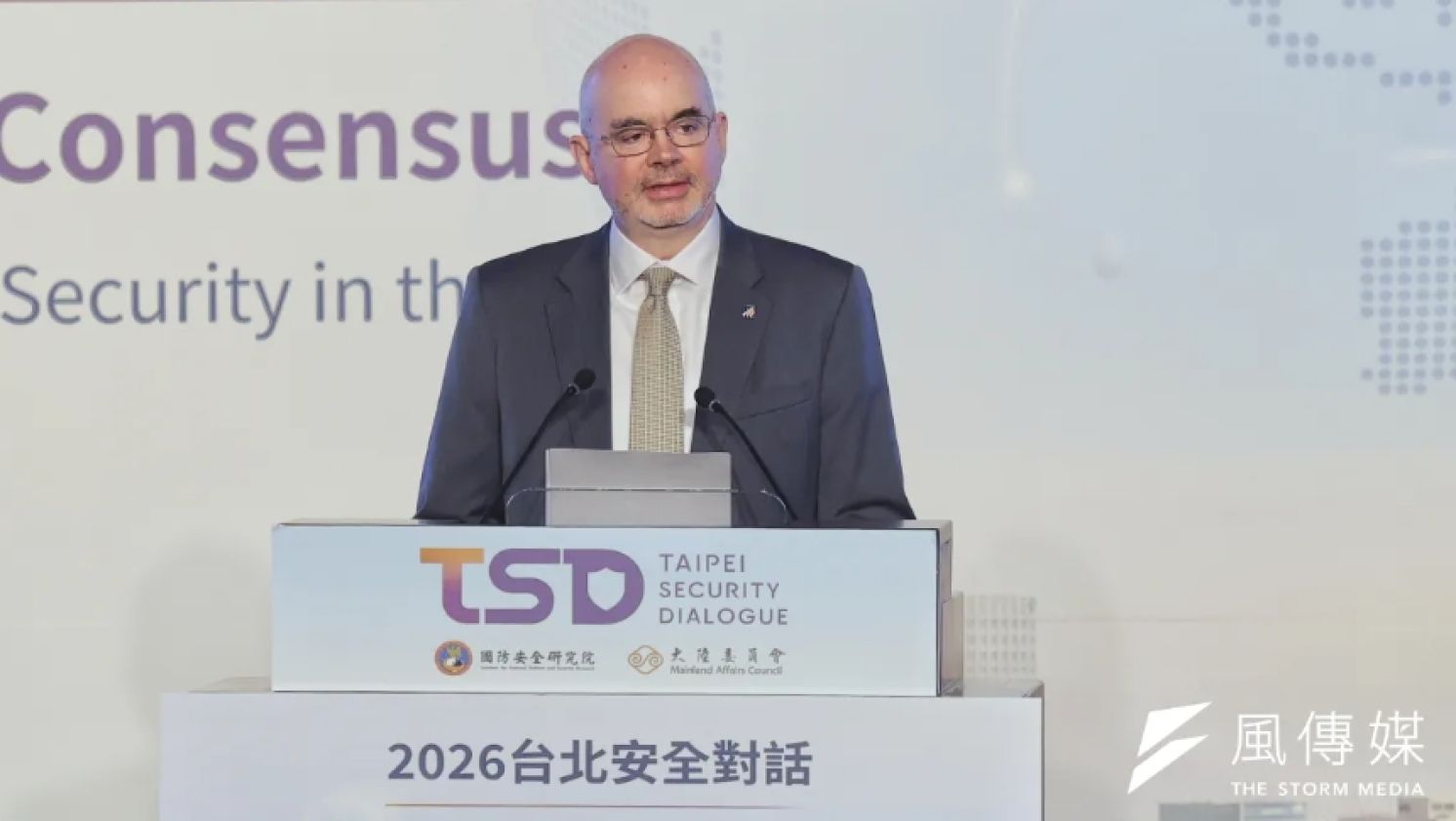
At the “2026 Taipei Security Dialogue,” Director Raymond Greene of the American Institute in Taiwan (AIT), who delivered opening remarks, encouraged Taiwan to follow Israel’s example by “regarding the reserves as an important force that can be rapidly mobilized,” but Taiwan’s commitment to raise defense spending to 5 percent of gross domestic product (GDP) by 2030 is “still not enough!” Because “when conflict occurs, the ability to recover is equally important, and this requires investment in the defense industrial base.”
While encouraging Taiwan to prepare for war, Director Greene did not forget to explain the meeting between President Donald Trump of the United States and Chinese President Xi Jinping in Washington at the end of the month: “Diplomatic activity at the highest level can further advance a strategically stable relationship and avoid miscalculation and misunderstanding.”
In contrast to Vice President Hsiao Bi-khim’s lament at another event that Beijing is unwilling to engage in dialogue with Taiwan’s democratically elected government, Mr. Trump also recently included the Taipei Economic and Cultural Representative Office in Washington among the targets of his criticism on Truth Social for funding left-wing think tanks. Taiwan, on the one hand, has to deal with U.S. demands for arms purchases, while on the other hand it has to endure Trump’s slaps from time to time. This fully explains The Atlantic’s doubts: “Taiwanese people don’t trust Trump, and they don’t believe the United States will come to protect them.”
In its report “Will Taiwan Just Give Up?”, The Atlantic conducted on-the-ground interviews and can be said to have accurately captured the contradictions in the Taiwanese public’s mindset. Are such contradictions not also America’s contradictions? Mr. Trump has repeatedly praised Mr. Xi and looked down on Taiwan, making clear that he does not want to fight a war 9,500 kilometers away for Taiwan independence. The report contains a scene that is extremely “vivid and striking”: the Center for Strategic and International Studies (CSIS) frequently conducts war games, and there is only one situation in which China would lose a war: Taiwan demonstrates the determination to fight back while the United States rapidly deploys all of its military forces to intervene. Neither can be missing, and both must “happen simultaneously.”
Mr. Trump can have a pleasant conversation with Mr. Xi because a leaders’ summit can advance a strategically stable relationship and avoid miscalculation and misunderstanding. Yet when it comes to Kuomintang (KMT) Chairwoman Cheng Li-wun’s meeting with Mr. Xi, “it is deemed absolutely unacceptable. The same applies to President Lai Ching-te of the ruling party, toward whom Trump has shown no courtesy, even refusing to allow President Lai to transit through New York.
Does Taiwan have the determination to defend itself? Even if the defense budget is raised to 5 percent GDP, of course it is still not enough! The United States has consistently been conservative regarding arms sales to Taiwan. It can neither sell offensive weapons, while Taiwan’s independent development of military weapons must also remain under U.S. control. Six years ago, Taiwan spent NT$250 billion (about US$7.7 billion) to purchase 66 F-16s, yet they have still not been delivered. There are also another NT$400 billion (about US$12.3 billion) worth of other projects, but there is still no sign of delivery.
Director Greene encouraged Taiwan to follow Israel’s example. Israel’s military weapons are all state-of-the-art equipment. In the sky are American-made F-35I and other stealth fighter jets; beneath the sea are Dolphin-class submarines capable of carrying medium-range cruise missiles and nuclear warheads; and there is also a multilayered missile interception defense network. The International Atomic Energy Agency believes that Israel “is a country possessing nuclear weapons.” What aspect of Taiwan can be compared with this?
The United States is asking Taiwan to vigorously develop unmanned military systems, from aircraft to vessels. This is indeed a new opportunity. The key question is how much support the Starlink system accompanying these drones can provide. Ukrainian attack drones can strike Russia’s Arctic industrial areas and oil refineries in Siberia, while Taiwan is permitted to develop “coastal surveillance and attack drones” that can only “attack” People’s Liberation Army (PLA) drones that have already reached the coast.
Taiwan’s greatest weakness is not merely that its military weapons are outdated and that it cannot keep up. Taiwan is an island without strategic depth. Once enemy forces reach the shoreline, it is already not far from “failure,” let alone the “porcupine republic” envisioned by American arms manufacturers, which would have its people carrying shoulder-fired missiles through the streets and alleys.